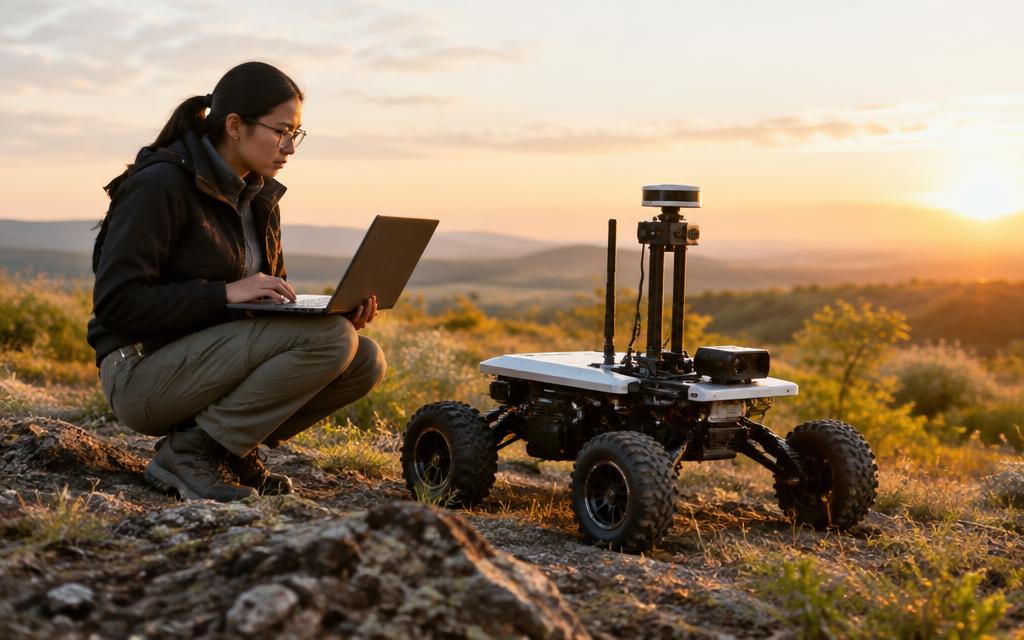
Robotics & Autonomous Systems
Software that lets machines perceive, plan, and move safely in the real world.
10 career guides in this field
Market Context
Where the Field Stands in 2026
The International Federation of Robotics reports more than four million industrial robots operating in factories worldwide, with annual installations above half a million units. Growth is now spreading beyond the factory floor into ports, farms, mines, warehouses, railways, oceans, and space — environments where autonomy software, not mechanical design, is the main bottleneck.
Employers want engineers who combine perception (cameras, lidar, radar, sonar), state estimation, motion planning, and real-time systems with a strong safety mindset. Functional-safety standards such as ISO 26262, IEC 61508, and domain-specific rules make verification and validation skills especially valuable.
Demand Drivers
- Labor shortages in logistics, agriculture, and mining that make automation economically compelling.
- Cheaper sensors and edge AI hardware, enabling autonomy in smaller and lower-cost machines.
- Space and ocean exploration programs with long-duration autonomous missions.
Honest Risks
- Hardware projects have long cycles; programs can be delayed or cancelled by funding and regulation.
- Field work and testing may require travel or remote-site deployments.
Sources
Career Guides
Roles Inside Robotics
 Robotics
 Process Automation (RPA) Developer
A Robotics Process Automation (RPA) Developer designs, builds, tests, and deploys software bots that automate repetitive, rule-based digital workflows across enterprise business operations.
Key Skills
 Robotics
Autonomous Marine Robotics Software Engineer
A Autonomous Marine Robotics Software Engineer designs, programs, and tests navigation, control, and perception software for unmanned surface vessels (USVs) and autonomous underwater vehicles (AUVs).
Key Skills
 Robotics
Spacecraft Flight Software Engineer
A Spacecraft Flight Software Engineer designs, writes, and verifies the mission-critical embedded software that controls satellites, interplanetary spaceprobes, lunar landers, and commercial orbita…
Key Skills
 Robotics
Autonomous Mining Equipment Software Engineer
A Autonomous Mining Equipment Software Engineer develops perception, localization, and motion control software for massive autonomous haul trucks, underground drill rigs, and heavy excavation machi…
Key Skills
 Robotics
Autonomous Drone Delivery Fleet Software Engineer
A Autonomous Drone Delivery Fleet Software Engineer designs, develops, and maintains flight control software, perception pipelines, and cloud fleet orchestration systems for commercial unmanned aer…
Key Skills
 Robotics
Autonomous Agricultural Machinery Software Engineer
A Autonomous Agricultural Machinery Software Engineer designs, programs, and tests navigation, perception, and implement-control software for autonomous tractors, combine harvesters, and robotic we…
Key Skills
 Robotics
Autonomous Port Logistics Automation Engineer
A Autonomous Port Logistics Automation Engineer designs, implements, and optimizes software control systems for automated container terminals, driverless transport vehicles, and robotic gantry cran…
Key Skills
 Robotics
Autonomous Lunar Rover Navigation Software Engineer
A Autonomous Lunar Rover Navigation Software Engineer designs, develops, and verifies autonomous guidance, navigation, and control (GNC) software for robotic rovers operating across the rugged, cra…
Key Skills
 Robotics
Autonomous Railway Train Control Software Engineer
A Autonomous Railway Train Control Software Engineer designs, implements, and verifies Communication-Based Train Control (CBTC) and Moving-Block signaling software for fully automated high-speed pa…
Key Skills
 Robotics
Autonomous Underwater Glider Software Engineer
A Autonomous Underwater Glider Software Engineer develops navigation, thermal buoyancy control, and low-power communication software for autonomous underwater gliders—unmanned subsea vehicles that…
Key Skills