Energy & Infrastructure
Digital engineering for grids, cities, and the climate transition.
5 career guides in this field
Market Context
Where the Field Stands in 2026
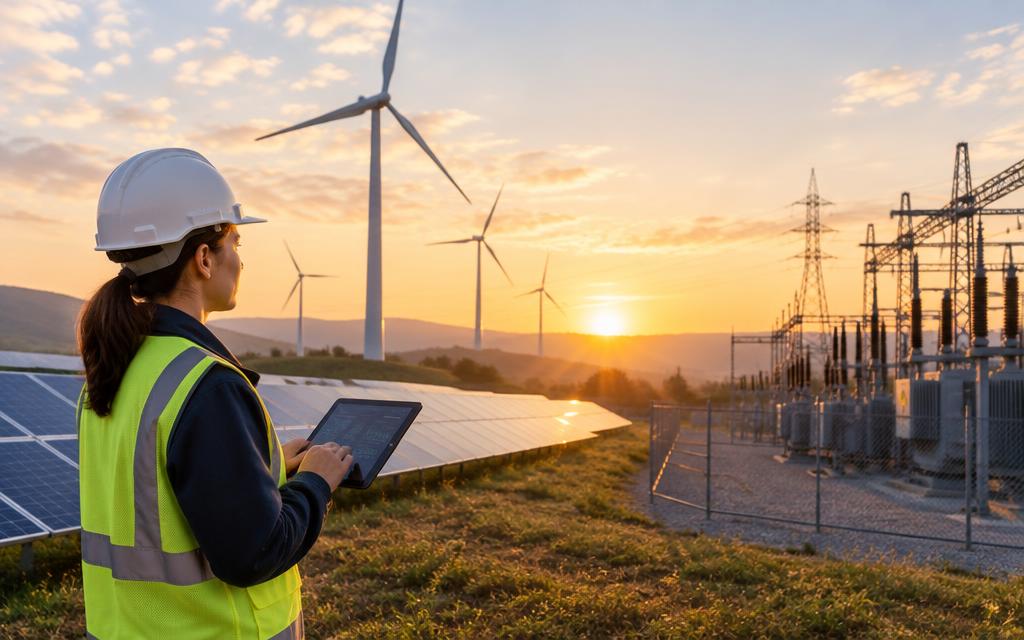
The International Energy Agency's World Energy Investment report shows global clean-energy investment now roughly double fossil-fuel investment. Each new solar farm, battery, offshore cable, and heat pump adds devices that must be monitored and controlled, so the energy transition is also a software and data transition.
The WEF Future of Jobs Report 2025 lists renewable energy engineers and environmental engineers among fast-growing roles, and green skills among those most in demand. Utilities, grid operators, nuclear operators, and carbon-removal companies increasingly hire control-system, digital-twin, and OT-security engineers who understand both physics and code.
Demand Drivers
- Grid modernization and interconnection queues that require advanced control and forecasting.
- Electricity demand from data centers and electrification of transport and heating.
- Climate policy and carbon markets supporting new categories such as direct air capture.
Honest Risks
- Projects are sensitive to interest rates and policy changes.
- Safety-critical and regulated environments slow deployment and require documentation discipline.
Sources
Career Guides
Roles Inside Energy
 Energy
Smart Grid Energy Systems Software Engineer
A Smart Grid Energy Systems Software Engineer develops the specialized software, control algorithms, and communication protocols that manage modern electrical power grids, renewable energy generati…
Key Skills
 Energy
Smart City IoT Infrastructure Software Engineer
A Smart City IoT Infrastructure Software Engineer develops the large-scale data ingestion pipelines, edge computing software, and centralized management platforms that orchestrate municipal Interne…
Key Skills
 Energy
Nuclear Reactor Digital Twin Software Engineer
A Nuclear Reactor Digital Twin Software Engineer designs, develops, and maintains high-fidelity computational simulation software that mirrors the thermal-hydraulic, neutronic, and mechanical behav…
Key Skills
 Energy
Subsea Energy Grid Control Software Engineer
A Subsea Energy Grid Control Software Engineer designs and programs supervisory control systems, power conversion algorithms, and communication software for unmanned subsea electrical substations a…
Key Skills
 Energy
Direct Air Capture Carbon Plant Automation Engineer
A Direct Air Capture Carbon Plant Automation Engineer designs, programs, and maintains industrial automation systems, SCADA software, and process control algorithms for massive Direct Air Capture (…
Key Skills